
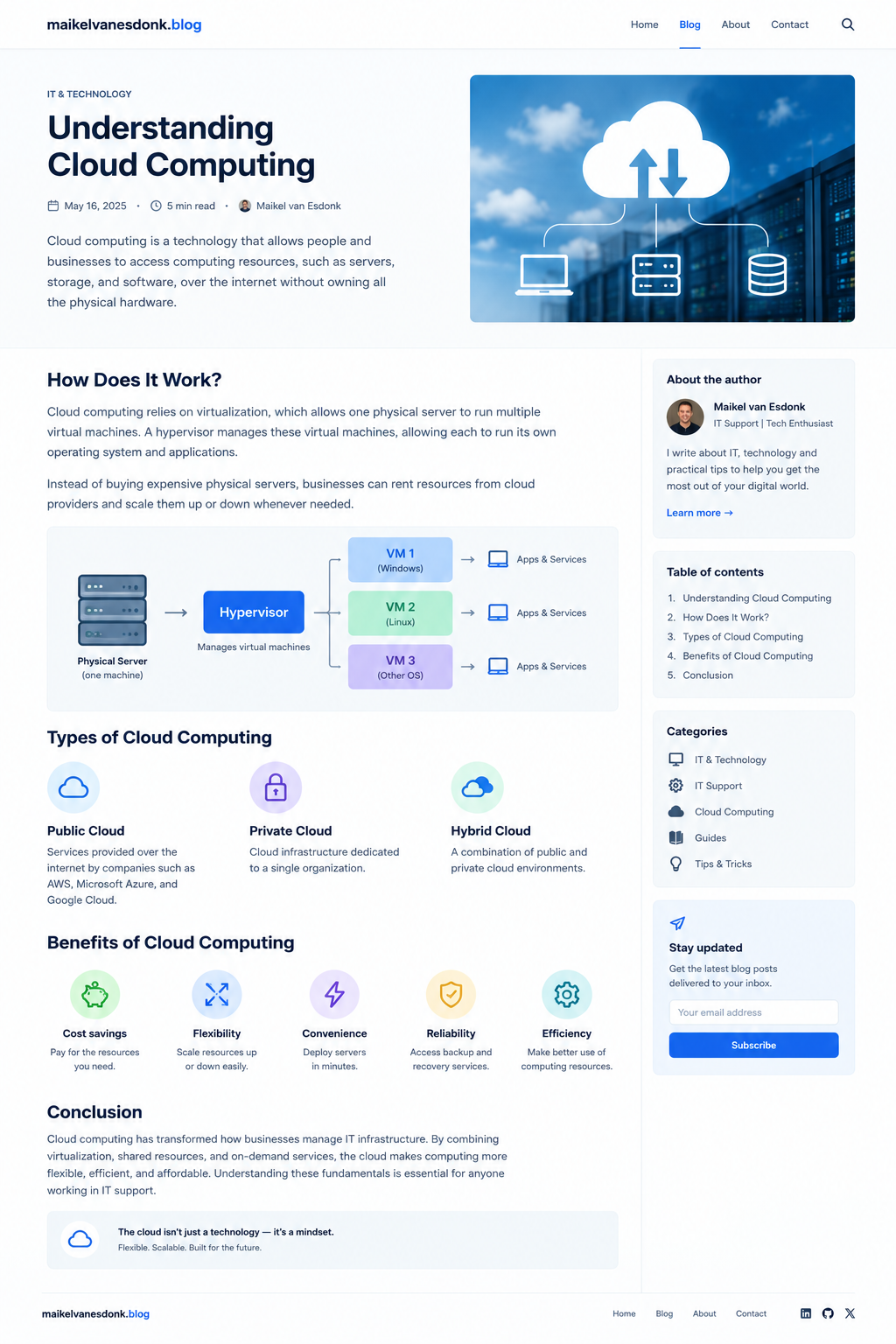
Cloud computing is a technology that allows people and businesses to access computing resources, such as servers, storage, and software, over the internet without owning all the physical hardware.
How Does That Work?
Cloud computing relies on virtualization, which allows one physical server to run multiple virtual machines.
A hypervisor manages these virtual machines, allowing each to run its own operating system and applications.
Instead of buying expensive physical servers, businesses can rent resources from cloud providers and scale them up or down whenever needed.
Types of Cloud Computing
Public Cloud
Services provided over the internet by companies such as AWS,
Microsoft Azure, and Google Cloud.
Private Cloud
Cloud infrastructure dedicated to a single organization.
Hybrid Cloud: A combination of public and private cloud environments.
Benefits of Cloud Computing
Cost savings: Pay for the resources you need.
Flexibility: Scale resources up or down easily.
Convenience: Deploy servers in minutes.
Reliability: Access backup and recovery services.
Efficiency: Make better use of computing resources.
Conclusion
Cloud computing has transformed how businesses manage IT infrastructure. By combining virtualization, shared resources, and on-demand services, the cloud makes computing more flexible, efficient, and affordable. Understanding these fundamentals is essential for anyone working in IT support.


Geef een reactie