
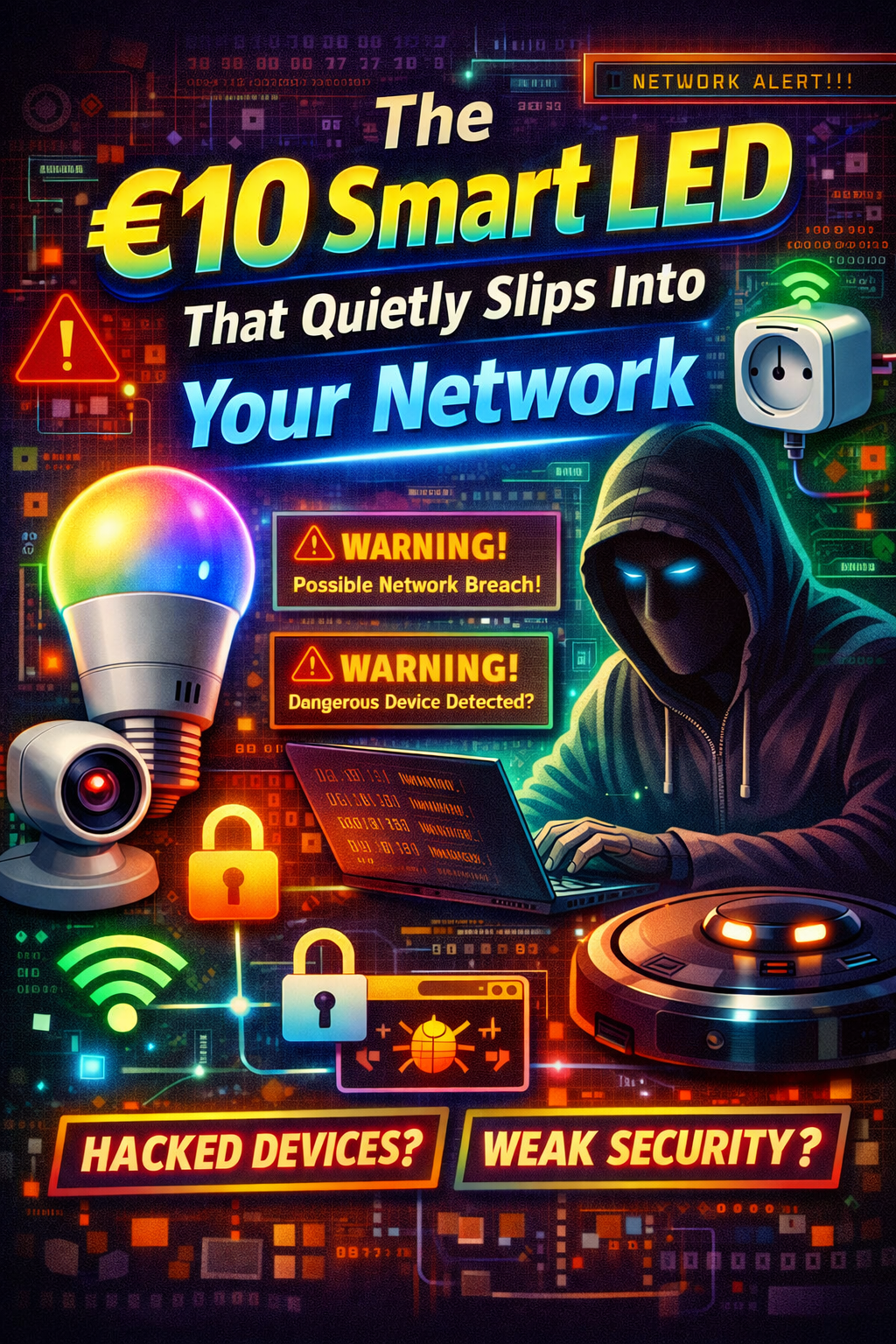
The €10 Smart LED That Quietly Slips Into Your Network
Shared networks are everywhere — in student houses, apartments, cafés, coworking spaces, and offices.
These networks often contain devices that aren’t yours: smart TVs, video doorbells, security cameras, robot vacuums, smart plugs, and colorful LED lights.
Convenient, affordable, and often surprisingly smart. But security is rarely the priority for manufacturers.
A VPN Doesn’t Always Protect What You Think
Many people rely on a VPN for privacy. And rightly so: a VPN encrypts your internet traffic and protects you from eavesdroppers on the internet or at your provider.
But there’s an important detail that often gets overlooked.
A VPN protects the connection between your device and the internet — not what happens inside the local network.
If another device on the same Wi-Fi network is compromised, it can still attempt to communicate locally with other devices.
- scanning the network
- detecting open ports
- searching for vulnerable services
- attempting local network manipulation
The Problem With Cheap “Smart” Devices
Many IoT devices operate through cloud servers. A smart lamp, doorbell, or camera connects to a server on the internet. The app on your phone then communicates with that same server.
That server acts as the middleman.
This means the device often maintains a constant connection to external systems — without you seeing exactly what’s happening.
- LED bulbs and light strips
- video doorbells
- Wi-Fi security cameras
- smart plugs
- thermostats
- robot vacuums
- smart speakers
Why Cheap Gadgets Sometimes Carry Risks
Behind many smart devices lies an economic reality.
Large retailers often purchase massive quantities at once. Manufacturers are asked to produce devices as cheaply as possible.
Who doesn’t want a smart lamp for ten euros?
But when margins become extremely small, budgets for things like:
- long-term software updates
- proper security testing
- stable firmware
- secure cloud infrastructure
…tend to disappear.
Bluetooth Devices Are Often Simpler
Interestingly, many Bluetooth devices are simpler from a network perspective.
When a device communicates only via Bluetooth with your phone, it usually doesn’t need to connect to the internet at all.
That eliminates a large portion of the network attack surface.
Why I’m Not a Fan of UPnP
Many routers include a feature called UPnP (Universal Plug and Play). The idea is convenience: devices can automatically open ports on the router without the user configuring anything.
A device can essentially ask:
“Open this port so people on the internet can reach me.”
More Control With MAC Address Filtering
A simple yet effective method is MAC address filtering.
- unknown devices are blocked
- new devices must be approved first
- suspicious devices can be denied immediately
Network Segmentation: The Real Solution
Professional environments use a different strategy: network segmentation.
- a network for laptops
- a network for servers
- a network for guests
- a network for IoT devices
Sometimes the Simplest Solution Is Your Phone
Modern smartphones can create a hotspot — essentially a private Wi-Fi network. Your laptop connects to your phone, and your phone uses the mobile network.
- you control the network
- no unknown devices
- works almost anywhere
The Conclusion
Smart devices make life easier. Lamps, cameras, and other gadgets are everywhere now.
But every new device also means new software entering your network.
Or as a system administrator might say:
“Before we add another smart gadget… let’s first see what it actually does.”



Geef een reactie