
Introduction
In modern IT environments, managing users, passwords, permissions and access to network resources can quickly become complicated. Especially in organizations with multiple servers, applications and hundreds or thousands of employees, managing everything separately is inefficient and difficult to maintain.
This is where LDAP (Lightweight Directory Access Protocol) comes into play.
LDAP provides a standardized way to access and manage information stored in a directory service. It is commonly used for centralized authentication, user management and access control.
In this article, we’ll explore what LDAP is, how it works, how directory entries are structured, and how LDAP helps organizations manage identities centrally.
1. What is LDAP?
LDAP stands for Lightweight Directory Access Protocol. It is an open protocol used by applications and systems to communicate with directory services.
A directory service is a centralized database designed to store information about users, computers, groups, organizations and other network resources.
Instead of maintaining separate user accounts on every system, an organization can use a central directory to manage identities and related information.
Common directory services that support LDAP include:
- Microsoft Active Directory
- OpenLDAP
- 389 Directory Server
- Apache Directory Server
LDAP is particularly useful in environments where multiple systems need access to the same identity information.
2. Why is LDAP important?
Imagine an organization with 200 employees and 50 different systems.
Without centralized identity management, administrators might need to create and maintain user accounts separately on every system.
This creates several challenges:
- Multiple accounts and passwords for the same employee.
- More administrative work.
- Inconsistent access permissions.
- Difficult account management when employees leave.
- Increased risk of forgotten or outdated accounts.
LDAP helps solve these problems by providing a central location for directory information.
The main benefits include:
Centralized Authentication
Users can authenticate against a central directory instead of having separate local accounts on every system.
Authorization
Access permissions can be managed based on users, groups and roles.
Accounting
Directory and authentication infrastructure can support auditing and logging of access-related activity. Accounting itself is not a core LDAP protocol operation, but can be implemented by surrounding systems.
Centralized Configuration Management
Administrators can maintain consistent directory information and access policies across connected systems.
3. Understanding LDAP directory entries
LDAP stores information in individual records called directory entries.
Each entry represents an object, such as a user, group, computer or organizational unit.
An entry consists of several important elements.
Distinguished Name (DN)
The Distinguished Name uniquely identifies an entry within the directory hierarchy.
For example:
CN=Maikel van Esdonk,OU=IT,DC=example,DC=com
This tells us that the entry belongs to the IT organizational unit within the example.com directory.
Common Name (CN)
The Common Name identifies an object by its name.
For example:
CN=Maikel van Esdonk
Attributes
Attributes contain information about the object.
Examples include:
cn– Common Namesn– SurnamegivenName– First namemail– Email addresstelephoneNumber– Phone numberuid– User identifier
Object Classes
Object classes define what type of object an entry represents and which attributes it can contain.
For example, an entry representing a person may use the inetOrgPerson object class.
Together, these elements describe the structure and contents of an LDAP directory entry.
4. How does LDAP work?
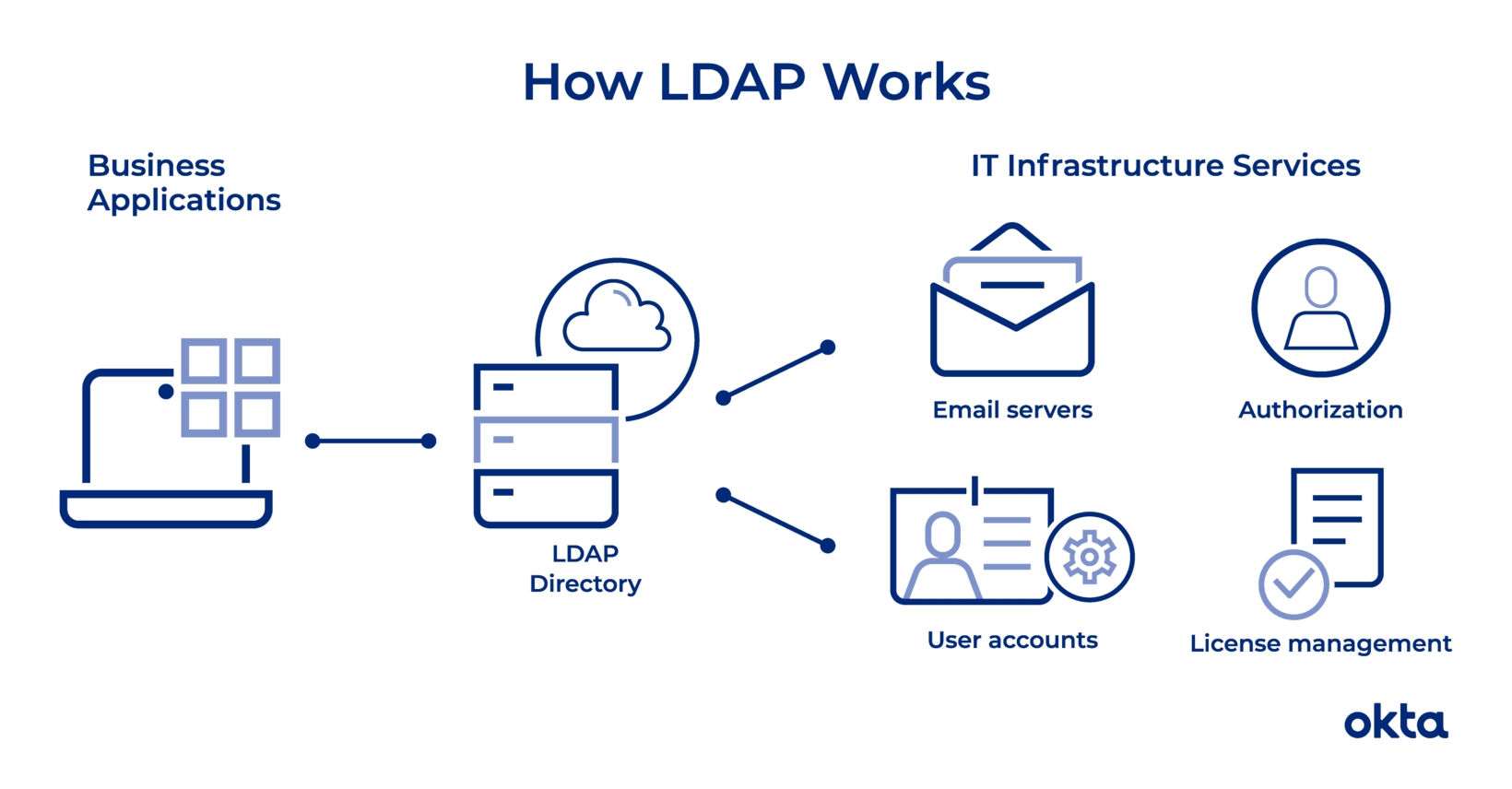
LDAP uses a client-server model.
The LDAP client sends requests to an LDAP directory server, which processes those requests and returns a response.
A typical communication process looks like this:
- An application connects to the LDAP server.
- The client authenticates using the LDAP Bind operation, if required.
- The client sends a request, such as a search for a user.
- The LDAP server processes the request.
- The server returns the requested information or an appropriate response.
LDAP supports several operations, including:
- Bind: Authenticates a client to the directory server.
- Search: Searches for entries and retrieves information.
- Add: Creates a new directory entry.
- Modify: Changes information in an existing entry.
- Delete: Removes an entry.
- Unbind: Ends the LDAP session.
These operations allow applications and administrators to interact with directory information in a standardized way.
5. The LDAP Bind operation
One of the most important LDAP operations is Bind.
The Bind operation allows a client to provide authentication information to the LDAP server. In simple terms, it is the operation used to authenticate a client.
LDAP supports different authentication approaches.
Anonymous authentication
An anonymous Bind does not provide a username and password. The server may allow limited access depending on its configuration.
Simple authentication
Simple Bind uses a Distinguished Name (DN) and password to authenticate the client.
For example, a client might authenticate using a user’s DN and password.
It is important to protect Simple Bind with TLS because passwords must not be exposed over an unprotected connection.
SASL authentication
SASL stands for Simple Authentication and Security Layer.
It allows LDAP to use different authentication mechanisms and can support additional security features, depending on the mechanism selected.
These authentication methods provide flexibility when integrating LDAP with different applications and environments.
6. LDAP and centralized authentication
One of the biggest advantages of LDAP is centralized authentication.
Consider an organization that uses several internal applications:
- A company intranet.
- A Linux server environment.
- A helpdesk application.
- A file server.
- Internal business applications.
Instead of maintaining separate user databases for every application, these systems can integrate with a central LDAP directory.
When a user attempts to log in, the application can contact the LDAP server to verify the user’s credentials.
This makes identity management easier and helps administrators maintain consistent access policies.
However, LDAP authentication does not automatically grant access to every application. Each application must also implement its own authorization rules.
7. LDAP security best practices
Because LDAP can contain sensitive information and is often involved in authentication, security is extremely important.
Some recommended practices include:
- Use TLS: Protect LDAP communication using LDAPS or StartTLS where appropriate.
- Avoid anonymous access: Restrict anonymous access unless there is a specific requirement.
- Apply least privilege: Give users and applications only the permissions they need.
- Use strong passwords: Enforce appropriate password policies.
- Monitor authentication activity: Review logs for suspicious login attempts.
- Protect service accounts: Use dedicated accounts with restricted permissions.
- Review access regularly: Remove unnecessary permissions and disable accounts that are no longer required.
Never expose LDAP credentials through an unencrypted connection.
8. LDAP vs. Active Directory
LDAP and Active Directory are closely related, but they are not the same thing.
LDAP is a protocol used to communicate with directory services.
Microsoft Active Directory is a directory service that supports LDAP, among other technologies and protocols.
In other words:
- LDAP defines how clients communicate with a directory.
- Active Directory provides a centralized directory and identity management environment.
- Applications can use LDAP to query Active Directory and authenticate users.
This distinction is important when working with enterprise identity management.
Conclusion
LDAP is an important technology in modern IT infrastructure. It provides a standardized way to access directory information and enables centralized user management and authentication.
By understanding directory entries, Distinguished Names, Common Names, attributes, object classes and the Bind operation, IT professionals can better understand how directory services work.
Whether you are managing a Linux environment with OpenLDAP or integrating applications with Microsoft Active Directory, LDAP remains a valuable technology for connecting systems and managing identities.
Centralized identity management makes IT environments easier to maintain, more consistent and potentially more secure when implemented with the right security controls.




Geef een reactie