
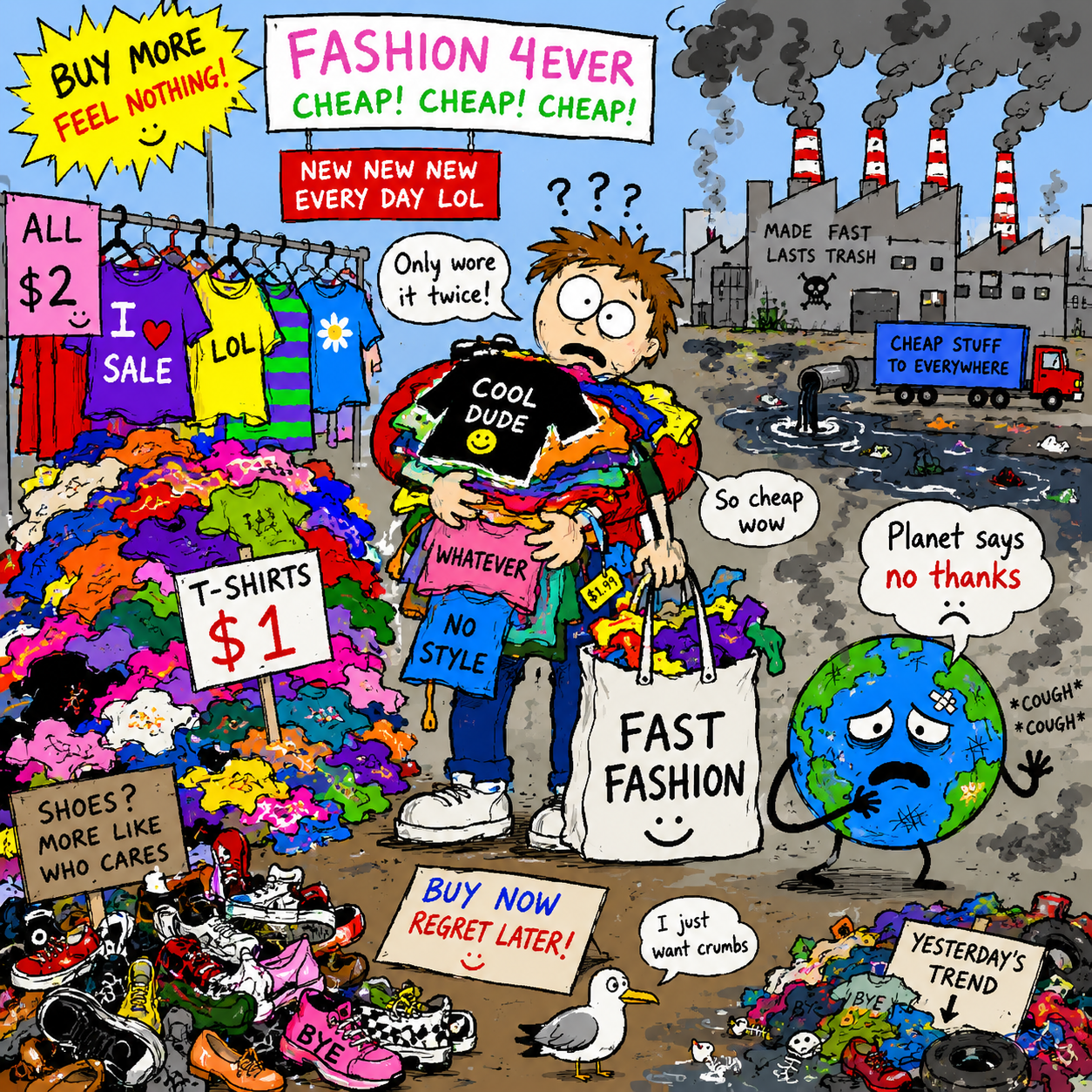
Fast Fashion: The Cheap Little Demon in Our Wardrobe
Fast fashion is weird.
On one hand, it gives ordinary people access to clothing they can actually afford. Which is nice, because not everyone has “€420 linen shirt” money. Some of us are out here buying Primark shoes and praying the sole survives winter.
On the other hand, the system behind cheap clothing is often a complete environmental and human disaster wearing a cute discount sticker.
Fast fashion is not always cheap because it is smart. Sometimes it is cheap because the real cost has been hidden somewhere very far away.
First: Let’s Not Pretend Poor People Are the Problem
This is important.
If someone buys shoes at Primark because they are broke, that person is not the villain of the story.
The villain is not the student, the single parent, the minimum-wage worker, or the guy who just needs black sneakers and has €18 left until payday.
The real problem is a system that makes responsible choices expensive, confusing, and sometimes completely impossible.
Telling poor people to “just buy sustainable fashion” is very cute advice if you also live inside a marble kitchen and drink emotional oat milk from a designer cup.
The perfect solution is not blaming poor people. The perfect solution is making better clothing affordable, durable, repairable, and honest.
Is Primark Worse Than Expensive Brands?
The honest answer: not automatically.
Cheap brands can be bad because they push huge volume, low prices, fast production, and constant consumption.
But expensive brands are not automatically saints either. A luxury label can charge €800 for a jacket and still have messy subcontractors, low-paid workers, vague supply chains, and enough marketing perfume to hide the smell.
More expensive does not always mean better working conditions. Sometimes it just means better lighting in the store.
- A cheap price can hide exploitation.
- An expensive price can hide exploitation with a nicer font.
- A “Made in Europe” label can still have problems.
- A sustainability campaign can still be mostly corporate yoga.
So no: buying expensive fashion is not automatically better.
Better is not about the price alone. Better is about how long the item lasts, how often you wear it, what it is made from, how transparent the brand is, and whether workers are treated like humans instead of invisible sewing machines.
The Real Monster Is Overproduction
The biggest problem is not one pair of cheap shoes.
The biggest problem is millions and millions of clothes being produced like the planet is a magical wardrobe with unlimited storage.
Fast fashion trains us to think clothing is temporary. Buy it. Wear it twice. Hate it. Replace it. Repeat until your closet looks like a textile landfill with hangers.
The demon is not fashion. The demon is speed.
Fashion used to be about taste, identity, culture, creativity, rebellion, beauty, and sometimes pretending you are cooler than you are.
Fast fashion turned it into endless scrolling, panic-buying, trend-chasing, and “this top was only €6 so who cares if it dies in the washing machine.”
The Plastic Problem in Our Clothes
A lot of modern clothing is basically plastic pretending to be fabric.
Polyester, acrylic, nylon — all very convenient, very cheap, and very good at sneaking tiny plastic fibres into the water when washed.
These tiny fibres are microplastics. They do not politely disappear because we ignored them. They can move through water, soil, animals, food chains, and eventually back to us.
So yes, your shirt may look innocent. But some shirts are basically little plastic confetti machines with sleeves.
Some clothes pollute even after you buy them. Very generous. Very cursed.
China, SHEIN, Primark, and the Global Blame Game
China plays a huge role in global clothing production. A lot of fast fashion depends on massive export manufacturing, coal-heavy energy, intense supplier pressure, and insane speed.
SHEIN made the machine feel almost instant. New trend? New product. New microtrend? New product. Someone blinked near a skirt? New product.
Primark helped normalize another part of the problem: extremely cheap clothing at huge scale.
But blaming only China is too easy.
Western brands wanted cheap production. Consumers wanted cheap prices. Social media wanted endless outfits. Investors wanted growth. Everyone pointed at everyone else while the planet quietly screamed into a polyester hoodie.
China did not invent greed. The West did not accidentally find cheap clothing under a tree. This machine was built because everyone wanted something from it.
The Workers Pay the Real Price
Cheap clothes are never magically cheap.
Somewhere in the chain, pressure lands on workers. Faster deadlines. Lower prices. Unsafe factories. Poverty wages. Too much overtime. Too little power.
And again: this is not only a fast-fashion problem. Luxury brands can have ugly supply chains too.
The fashion industry is very good at selling dreams while hiding the people who made them.
- The consumer sees the price.
- The brand sees the margin.
- The worker feels the pressure.
- The planet receives the invoice.
So What Should Normal People Actually Do?
Here is the realistic answer.
Do not buy five cheap things when one decent thing would last longer.
But if Primark is what you can afford, do not spiral into moral guilt because you bought shoes. Just wear them as long as possible. Repair them if you can. Do not treat them like disposable garbage.
The best clothing choice is often not “expensive.” The best clothing choice is:
- Something you actually need.
- Something you will wear many times.
- Something that lasts.
- Something second-hand, if possible.
- Something you do not throw away because TikTok got bored.
Vinted, thrift shops, clothing swaps, repairs, buying less, washing smarter, avoiding pointless trend hauls — these are not perfect solutions, but they are real.
And honestly, wearing the same good outfit again should be normal. The idea that every photo needs a new outfit is one of the dumbest spells capitalism ever cast on people.
Repeating outfits is not embarrassing. Throwing away clothes like they are napkins is embarrassing.
Fashion Can Still Be Beautiful
This is not an article against fashion.
Fashion is beautiful. It can be art, memory, confidence, culture, rebellion, elegance, identity, and pure personal joy.
The problem is not that people want to look good.
The problem is that the industry turned looking good into a never-ending shopping treadmill.
We do not need to kill fashion. We need to kill the idea that clothing should be cheap, instant, disposable, and consequence-free.
The Perfect Solution
The perfect solution is not “poor people should buy €300 ethical trousers.”
The perfect solution is:
- Brands producing less, but better.
- Clothing designed to last longer.
- Workers paid properly.
- Supply chains that are transparent.
- Repair and second-hand becoming normal.
- Sustainable options becoming affordable.
- Less fake green marketing and more actual responsibility.
Until then, the most realistic personal rule is simple:
Buy less. Wear longer. Repair more. Reuse first. And do not let brands sell you guilt while they keep producing mountains of trash.
Fast fashion is not evil because poor people need cheap clothes.
Fast fashion is evil because it takes that need, exploits it, accelerates it, markets it, and turns it into endless waste.
So yes, buy the Primark shoes if you need them.
Just do not buy seven pairs because the algorithm whispered “new era” into your financially unstable little soul.
Fashion should make people feel alive. It should not require workers, rivers, oceans, and future generations to quietly suffer in the background.




Geef een reactie